


En-Hui Yang
Co-authorDepartment of Electrical and Computer Engineering, University of Waterloo, Waterloo, ON N2L 3G1, Canada
Entropy Vol. 23, Issue 7, Jul 10, 2021
The impact of JPEG compression on deep learning (DL) in image classification is revisited.
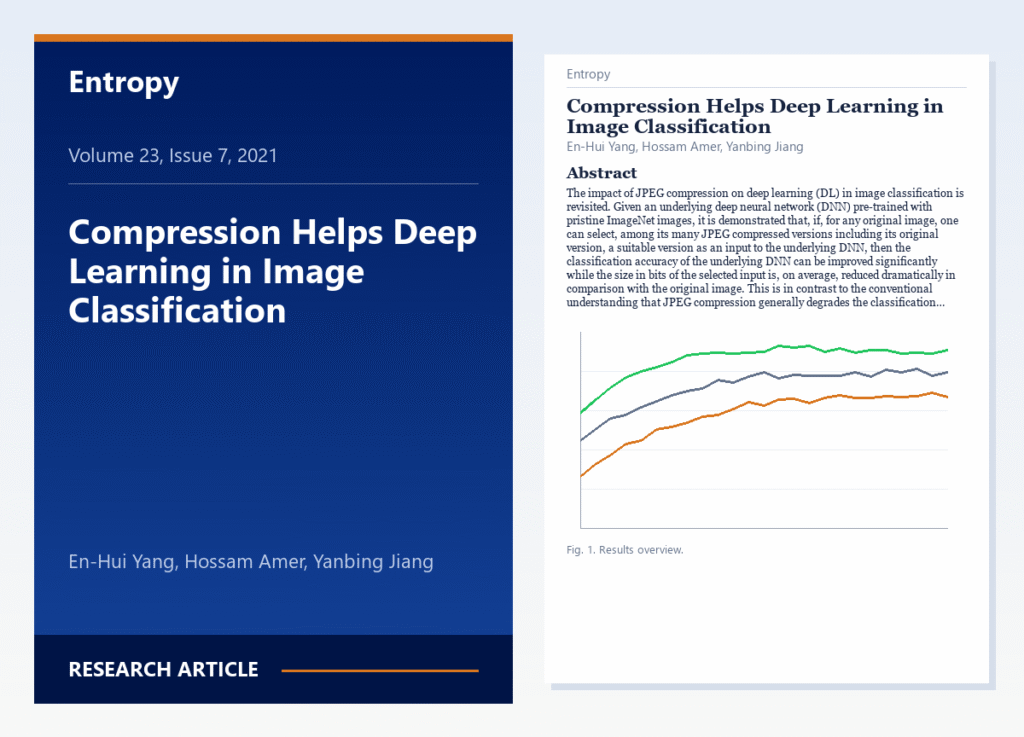
The impact of JPEG compression on deep learning (DL) in image classification is revisited. Given an underlying deep neural network (DNN) pre-trained with pristine ImageNet images, it is demonstrated that, if, for any original image, one can select, among its many JPEG compressed versions including its original version, a suitable version as an input to the underlying DNN, then the classification accuracy of the underlying DNN can be improved significantly while the size in bits of the selected input is, on average, reduced dramatically in comparison with the original image. This is in contrast to the conventional understanding that JPEG compression generally degrades the classification accuracy of DL. Specifically, for each original image, consider its 10 JPEG compressed versions with their quality factor (QF) values from {100,90,80,70,60,50,40,30,20,10}. Under the assumption that the ground truth label of the original image is known at the time of selecting an input, but unknown to the underlying DNN, we present a selector called Highest Rank Selector (HRS). It is shown that HRS is optimal in the sense of achieving the highest Top k accuracy on any set of images for any k among all possible selectors. When the underlying DNN is Inception V3 or ResNet-50 V2, HRS improves, on average, the Top 1 classification accuracy and Top 5 classification accuracy on the whole ImageNet validation dataset by 5.6% and 1.9%, respectively, while reducing the input size in bits dramatically—the compression ratio (CR) between the size of the original images and the size of the selected input images by HRS is 8 for the whole ImageNet validation dataset. When the ground truth label of the original image is unknown at the time of selection, we further propose a new convolutional neural network (CNN) topology which is based on the underlying DNN and takes the original image and its 10 JPEG compressed versions as 11 parallel inputs. It is demonstrated that the proposed new CNN topology, even when partially trained, can consistently improve the Top 1 accuracy of Inception V3 and ResNet-50 V2 by approximately 0.4% and the Top 5 accuracy of Inception V3 and ResNet-50 V2 by 0.32% and 0.2%, respectively. Other selectors without the knowledge of the ground truth label of the original image are also presented. They maintain the Top 1 accuracy, the Top 5 accuracy, or the Top 1 and Top 5 accuracy of the underlying DNN, while achieving CRs of 8.8, 3.3, and 3.1, respectively.
Yang, E. H., Amer, H., & Jiang, Y. (2021). Compression Helps Deep Learning in Image Classification. Entropy, 23(7), 881. https://doi.org/10.3390/e23070881
@article{yang2021,
  title = {Compression Helps Deep Learning in Image Classification},
  author = {Yang, En-Hui and Amer, Hossam and Jiang, Yanbing},
  journal = {Entropy},
  year = {2021},
  volume = {23},
  number = {7},
  pages = {881},
  issn = {1099-4300},
  doi = {10.3390/e23070881}
}
%0 Journal Article
%T Compression Helps Deep Learning in Image Classification
%A Yang, En-Hui
%A Amer, Hossam
%A Jiang, Yanbing
%J Entropy
%V 23
%N 7
%P 881
%D 2021
%@ 1099-4300
%R 10.3390/e23070881
%U https://doi.org/10.3390/e23070881
TY  - JOUR
TI  - Compression Helps Deep Learning in Image Classification
AU  - Yang, En-Hui
AU  - Amer, Hossam
AU  - Jiang, Yanbing
JO  - Entropy
VL  - 23
IS  - 7
SP  - 881
PY  - 2021
SN  - 1099-4300
DO  - 10.3390/e23070881
UR  - https://doi.org/10.3390/e23070881
ER  -
100% secure payment
Access immediately
Premium quality content
We're here to help
30-day money back


Read this paper? Share your thoughts to help other researchers decide.